All art examples adapted from: Armfuls of Time:
The Psychological Experience of
a Child with a Life-Threatening Illness
by Barbara M. Sourkes, Ph.D.
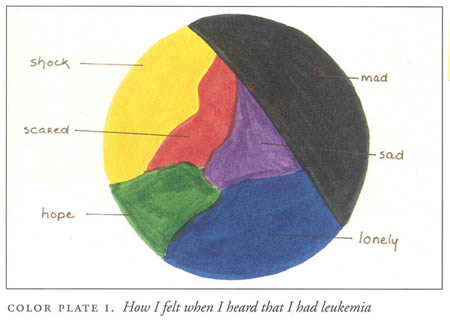
Example 1: Color Plate I
"When I heard that I had leukemia, I turned pale with shock. That's why I chose YELLOW -- it's a pale color. Scared is RED -- for blood. I was scared of needles, of seeing all the doctors, of what was going to happen to me. I was MAD [BLACK] about a lot of things: staying in the hospital, taking medicines, bone marrows, spinal taps, IV's, being awakened in the middle of the night. I was sad [PURPLE] that I didn't have my toys and that I was missing out on everything. I chose BLUE for lonely because I was crying about not being at home and not being able to go outside. GREEN is for hope: getting better, going home, eating food from home, and seeing my friends."
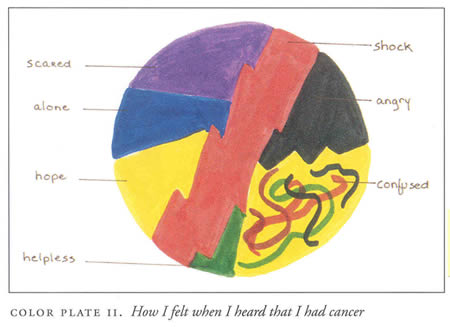
Example 2: Color Plate II
"RED is for shock -- it's like coming to a stoplight, or like being hit by a bolt of lightning. Anger is BLACK because it's a very, very dark feeling. You feel scared all the time of what is going to happen to you [PURPLE]. Alone is BLUE, for tears, because you are so sad. I chose YELLOW for hope, because it's a sunny color, with a lot of light. Helpless [GREEN] is little in my drawing, because that's just how you feel -- tiny and scared. I made confused a mixture of all the colors together. You're just confused about everything going on and how this could all be happening to you."
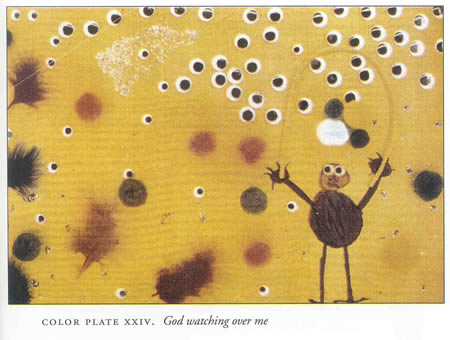
Example 3: Color Plate XXIV
"An eight-year-old boy who has just relapsed worked on this picture in the playroom. In response to the child life specialist's query about all the "eyes" that he had so carefully glued onto the paper, he explained: 'It's God watching over me'."
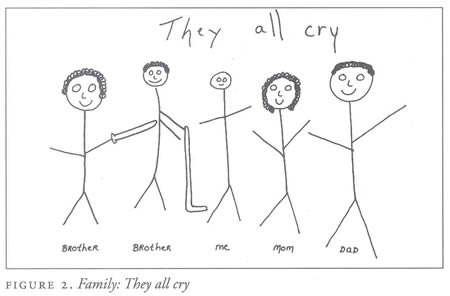
Example 4: Figure 2
"An eight-year-old boy hastily drew stick figures to illustrate the members of his family. One brother was playing baseball, another playing hockey, and the patient himself was bald, had no mouth, and was not doing anything. Neither were the parents engaged in any activity. When asked what changed in his family after he became ill, the boy immediately scrawled: "They all cry." This is a striking portrait of anticipatory grief within the family system."
Caring for a Child Approaching the End of Life
& Keeping the Family Together: Ways Dying Children & Their Siblings Communicate Their Needs
"Once you have a disease, people treat you as if you're not capable. Even though it's not true, it makes you feel really bad about yourself. " Anonymous 11 yr old; Armfuls of Time by Sourkes